Origin of the Hound of the Baskervilles legend
The Hound of the BaskervillesThe Origin of the Hound of the Baskervilles legend is a family manuscript’s account of Hugo Baskerville’s pursuit of a young woman and the deaths that followed. It turns a violent episode at Baskerville Hall into an inheritance of fear: a supernatural beast appears to kill Hugo, and the family is warned against repeating the passions associated with its past. Later events expose the legend’s other life—as local belief, personal terror, and a practical device for concealing a human crime.
The manuscript and its warning
The tale is read aloud by Dr. Mortimer as part of the explanation for the danger surrounding the Baskerville family. Its narrator claims descent in a direct line from Hugo Baskerville and says that the story came to him through his father and grandfather. The manuscript is thus presented not as an outsider’s account but as family testimony, preserved across generations. A note attributes it to Hugo and says it was addressed to his sons, with an instruction to keep it from their sister. The tale’s transmission is selective even within the family it purports to warn.
Its opening frames the story as moral instruction rather than mere marvel. The narrator urges his descendants not to fear the past as an unavoidable curse, but to guard against the passions that caused the family’s suffering. He also invokes the possibility of forgiveness and the eventual limit of inherited punishment. This qualification sits uneasily beside the alarming account that follows: the story gives the family’s fear a memorable supernatural shape, even as it counsels its heirs not to be ruled by that fear.
The setting is the Great Rebellion, when Hugo holds the manor at Baskerville Hall. The manuscript depicts him as a notorious and cruel landowner. He becomes fixated on the daughter of a nearby yeoman, who avoids him because of his reputation. The account makes the contrast between his power and her refusal central to what follows: the legend begins not with an unexplained beast, but with human conduct and an abuse of authority.
The pursuit across the moor
At Michaelmas, while the young woman’s father and brothers are away, Hugo and five or six companions take her to the Hall. She is kept in an upper chamber while the men drink below. When Hugo later discovers that she has escaped, he reacts with fury and declares his willingness to give himself to evil powers if he can catch her. One of his companions proposes setting the hounds on her. Hugo orders his grooms to prepare his mare and the pack, gives the dogs her kerchief, and rides out after her across the moor by moonlight.
The escape and pursuit set the story’s human and supernatural elements on intersecting paths. The young woman gets down the ivy-covered south wall and travels the three leagues toward her father’s farm; Hugo follows with the hounds, while his drinking companions eventually ride after him. Thirteen men join the chase. Their number and drunken disorder initially make the pursuit seem like an extension of the revelry, but the account changes register when a night shepherd reports seeing the woman pursued by the pack and Hugo riding behind her with a dreadful hound.
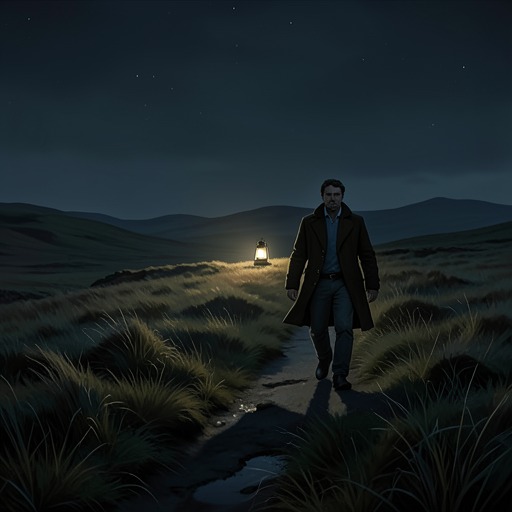
The company then encounters signs that divide ordinary pursuit from the legend’s supernatural explanation. Hugo’s black mare passes them riderless, its bridle trailing. They find the pack gathered at a deep hollow, reluctant to advance. In a clearing near two ancient stones, the three men bold enough to ride forward find the young woman dead from fear and exhaustion and Hugo lying nearby. The manuscript says that a great black beast shaped like an enormous hound stands over him. The witnesses flee; one is said to die that night from what he saw, while the other two remain broken by the experience. The tale’s decisive horror is therefore not only the deaths, but the apparent collapse of the pursuers’ confidence in the natural world.
From family account to local belief
The manuscript presents this episode as the beginning of the hound said to have plagued the family thereafter. It links the founding story to later deaths described as sudden, violent, and mysterious, and turns the moor at night into a place to avoid. The warning is concrete: descendants should not cross it in the dark hours when evil powers are believed to be strongest. In this way, the story preserves both a family memory and a rule of conduct, allowing an account of the past to shape decisions in the present.
The legend also circulates beyond the manuscript. After the death of Sir Charles Baskerville, Dr. Mortimer reports that several local people had seen a huge, luminous, spectral creature on the moor before the tragedy. He says that he questioned a countryman, a farrier, and a moorland farmer, each of whom described an apparition resembling the legendary hound. Their accounts, as Mortimer presents them, appear to confirm the old story and help explain the fear surrounding nighttime travel. Sir Charles himself had been deeply affected by the tale; the legend was therefore not simply inherited background but part of the atmosphere in which the later tragedy was understood.
The hound’s human explanation
The final investigation reinterprets the apparent supernatural evidence without erasing the legend’s influence. At the abandoned mine where the hound had been concealed, the investigators find its confinement place, gnawed bones, and a skeleton identified as a dog. Dr. Mortimer recognizes it as his missing curly-haired spaniel. Sherlock Holmes also identifies a luminous mixture kept in a tin: the substance used to make the animal glow. The creature that seemed to confirm the family story was an ordinary dog made terrifying by its appearance and by the darkness of the moor.
Holmes connects the trick directly to the old tale. The legend suggested the disguise, while fear of the family’s supposed hell-hound discouraged witnesses from examining what they had seen. The same device could frighten victims and make local reports sound like evidence of a curse. In the case of Sir Charles, Holmes explains, the hound was used to frighten him to death. Thus the manuscript’s account remains consequential even when its supernatural explanation fails: the story’s power lies partly in how a later criminal can turn inherited belief into cover for deliberate action. The origin legend begins as a warning about destructive passions, becomes a source of communal terror, and finally reveals how readily fear of the past can be used to produce danger in the present.